



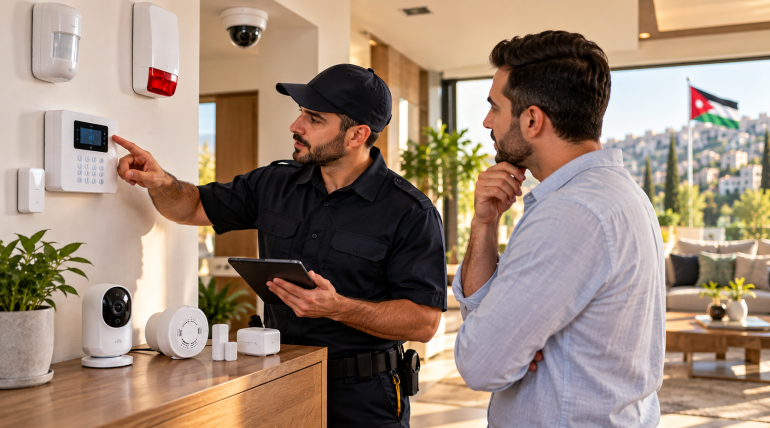
Choosing the right alarm company is an important step toward protecting your home, business, employees, assets, and property. With many security providers offering different technologies and levels of service, it can be difficult to determine which company can provide the reliability, professionalism, and response capabilities you actually need.
A professional security provider should offer more than alarm equipment. Effective protection combines appropriate technology, professional monitoring, trained personnel, clear response procedures, and security solutions tailored to the risks associated with each property.
Whether you are protecting a private residence, commercial facility, warehouse, office, or industrial site, this guide explains what to look for when comparing alarm companies and how to select a security partner that meets your requirements.
With more than a decade of experience in Jordan, Quick Intervention for Security & Armed Protection (Q.I.S.P) provides integrated security solutions designed to support the protection of individuals, businesses, institutions, and properties.
What Do Alarm Companies Do?
Alarm companies provide security solutions designed to detect potential threats and support an appropriate response when an incident occurs.
Depending on the provider and the requirements of the property, services may include:
- Intrusion detection systems
- Motion detection
- Door and window protection
- Surveillance solutions
- 24/7 monitoring
- Alarm verification
- Rapid security response
- Security patrols
- Physical security personnel
- Risk assessment and security consulting
The most effective approach is often an integrated security solution in which technology and trained personnel work together rather than relying on a single layer of protection.
What Are Alarm Companies and Why Do They Matter?
Professional alarm companies help protect properties by combining detection technologies, monitoring procedures, and security response measures.
While basic alarm systems may provide a local warning when an incident occurs, professionally managed security solutions can provide additional layers of protection through continuous monitoring and coordinated response procedures.
A professional security provider may offer:
- Proper installation and configuration of security systems
- 24/7 monitoring and supervision
- Trained security response personnel
- Preventive security measures
- Regular system support and maintenance
- Security assessments based on the property and its risks
For homes, businesses, commercial facilities, and industrial properties, selecting an experienced and properly licensed security provider is an important part of developing an effective security strategy.
Security Services to Consider When Choosing an Alarm Company
Not every alarm company provides the same range or level of service. Before choosing a provider, it is important to understand the different components that may form part of an integrated security solution.
1. Smart Alarm Systems and Rapid Response
Modern alarm systems can provide significantly more functionality than a traditional siren.
Depending on the system configuration, security technology may include:
- Motion sensors
- Door and window sensors
- Glass-break detection
- Smoke and fire detection
- Surveillance cameras
- Remote monitoring capabilities
- Automated alerts and notifications
The real value of an alarm system, however, is not limited to detecting an incident. The procedures that follow an alarm activation are equally important.
At Quick Intervention for Security & Armed Protection (Q.I.S.P), security technology can form part of a broader protection strategy supported by professional security procedures and rapid-response capabilities according to the client’s requirements and the nature of the protected location.
2. Armed and Unarmed Security Guards
Technology plays an important role in modern security, but trained security personnel remain essential in many environments.
Depending on the property’s risk assessment and operational requirements, security services may include:
- Armed security personnel for appropriate high-risk environments
- Unarmed security guards
- Access-control personnel
- Security coverage for commercial and industrial facilities
- Security personnel for residential properties
- Event and special-purpose security
Professional security guards provide a visible security presence while helping control access, identify suspicious activity, respond to incidents, and support established security procedures.
The number and type of security personnel should be determined according to the site’s size, operating hours, access points, threat profile, and specific security requirements.
3. Mobile Security Patrols
Mobile security patrols can provide flexible coverage for properties that may not require permanent security personnel at every location.
Patrol services may include:
- Scheduled security inspections
- Checks of entrances, gates, and perimeter areas
- Monitoring of vulnerable locations
- Documentation of patrol activity
- Security response when required
- Visible security presence
Mobile patrols can be particularly useful for warehouses, commercial facilities, construction sites, residential compounds, farms, and organizations operating across multiple locations.
They can also complement fixed security guards and electronic security systems as part of a layered protection strategy.
4. Security for Cash and Valuables Movement
The movement of cash, documents, or valuable assets can create additional security risks.
Where appropriate and in accordance with applicable requirements, specialized security support may include:
- Trained security escorts
- Operational planning
- Route and risk assessment
- Coordination of movement procedures
- Measures designed to reduce unnecessary exposure during transit
These services may be relevant to businesses and organizations that regularly handle valuable assets or sensitive materials.
5. Home, Villa, and Property Protection
Residential properties can face different security challenges from commercial facilities.
Villas, farms, and larger private properties may have multiple entrances, extensive outdoor areas, perimeter vulnerabilities, or periods when the property is unoccupied.
A residential security solution may therefore combine:
- Alarm monitoring
- Surveillance cameras
- Motion and intrusion detection
- Security patrols
- Physical security personnel where required
- Access-control measures
- Security assessment of the property
Rather than relying on a standard package, residential protection should be designed around the property’s layout, occupancy, location, and specific security risks.
6. Risk Assessment and Security Consulting
Effective security should begin with understanding the risks.
Before recommending guards, cameras, alarms, or other security measures, a professional security provider should evaluate the property and identify potential vulnerabilities.
A security assessment may examine:
- Entrances and exits
- Perimeter security
- Blind spots
- Lighting conditions
- Access-control procedures
- Existing surveillance coverage
- Operational vulnerabilities
- Potential threats associated with the location
- Emergency and response procedures
The objective is to develop a security plan in which resources are deployed according to actual requirements rather than applying the same solution to every client.
How to Choose the Right Alarm Company
When comparing alarm companies, price should not be the only consideration.
Security is a long-term operational responsibility, and the quality of the provider, its personnel, procedures, technology, and response capabilities can be just as important as the equipment itself.
1. Verify Licensing and Compliance
Always verify that the security provider operates in accordance with the applicable licensing and regulatory requirements.
Working with a properly licensed security company provides greater confidence that services are delivered within an established professional and regulatory framework.
2. Consider Experience and Track Record
Experience is particularly important in the security industry.
An established company is more likely to have dealt with different property types, operational environments, and security scenarios.
Quick Intervention for Security & Armed Protection (Q.I.S.P) has more than a decade of experience providing security solutions in Jordan.
This experience supports the company’s ability to develop solutions for different environments, from private properties and commercial premises to larger institutional and operational facilities.
3. Evaluate the Technology
Ask the provider about the technology used in its security solutions.
Important questions may include:
- Is the equipment suitable for the property’s requirements?
- Can the system be expanded in the future?
- Can different security components work together?
- Are remote monitoring capabilities available where required?
- How are alarms received and handled?
- What maintenance and technical support are provided?
Security technology should support the overall security strategy rather than operate as an isolated component.
4. Understand the Response Procedures
Detection alone is not enough.
Ask what happens after an alarm is received.
A professional provider should be able to explain its procedures clearly, including:
- How alarms are received
- How incidents are verified
- Who is notified?
- How response personnel are coordinated
- How incidents are documented
- What escalation procedures are followed
Response arrangements may vary according to the location, type of incident, contractual scope, and operational requirements.
5. Look for Customized Security Solutions
Every property has different risks.
A warehouse does not require the same security plan as a private villa, hospital, office building, factory, shopping center, or event venue.
Avoid relying exclusively on standardized packages when your property requires a more detailed security approach.
A professional security provider should assess the site first and then recommend an appropriate combination of technology, personnel, and operational procedures.
6. Consider 24/7 Operational Capability
Security incidents can occur at any time.
When evaluating providers, ask about their ability to support security operations outside normal business hours and how incidents are handled during nights, weekends, and holidays.
For properties requiring continuous protection, 24/7 monitoring and operational readiness can be an important part of the overall security solution.
Why Integrated Security Provides Stronger Protection
One of the limitations of relying on a single security measure is that every security layer performs a different function.
For example:
Security Layer
Primary Purpose
Alarm Systems
Detect and generate alerts
Surveillance Cameras
Monitor and document activity
Security Guards
Provide physical presence and response
Mobile Patrols
Extend security coverage across wider areas
Monitoring Operations
Receive, assess, and coordinate alerts
Risk Assessment
Identify vulnerabilities and improve prevention
An alarm can detect an intrusion, but it cannot physically intervene.
A camera can record an incident, but recording alone does not prevent it.
A security guard can respond physically, but technology can significantly improve situational awareness and detection capabilities.
For this reason, integrated security combines multiple layers into a coordinated protection strategy.
Quick Intervention for Security & Armed Protection (Q.I.S.P) follows this integrated approach by combining professional security personnel, security technology, operational procedures, patrol capabilities, and risk assessment according to each client’s requirements.
Frequently Asked Questions About Alarm Companies
What is the difference between monitored and unmonitored alarm systems?
A monitored alarm system communicates alerts to a monitoring operation where the event can be handled according to established procedures.
An unmonitored alarm typically generates an alert or siren at the property but may depend on the property owner or another person to notice the alarm and take action.
The appropriate solution depends on the property’s risk level and security requirements.
How much do professional alarm and security services cost?
Costs vary depending on several factors, including:
- Property size
- Number of access points
- Required equipment
- Monitoring requirements
- Number of security personnel
- Operating hours
- Location
- Level of risk
- Required response arrangements
A professional provider should evaluate your requirements before preparing a customized quotation.
Can alarm companies protect both homes and businesses?
Yes. Security solutions can be designed for residential, commercial, institutional, and industrial environments.
However, the appropriate system and level of protection will differ according to the property’s size, use, location, operating conditions, and risk profile.
What happens when an alarm is triggered?
The exact procedure depends on the provider and the agreed security plan.
Depending on the system and service arrangement, an alarm may be received by a monitoring operation, assessed or verified, and handled according to established response and escalation procedures.
Clients should ask their provider to explain these procedures before activating the service.
How long does it take to install a professional alarm system?
Installation time depends on the size of the property, number of devices, system complexity, existing infrastructure, and integration requirements.
Smaller installations may require relatively limited time, while larger commercial or industrial projects may require additional planning, configuration, testing, and commissioning.
Choose a Security Partner, Not Just an Alarm System
Choosing among alarm companies should not simply be a comparison of equipment and prices.
The objective is to find a security partner capable of understanding your risks and developing an appropriate protection strategy.
Effective security can combine:
- Professional security personnel
- Alarm and detection technology
- Surveillance
- Monitoring
- Mobile patrols
- Rapid-response capabilities
- Risk assessment
- Clearly defined security procedures
With more than a decade of experience in Jordan, Quick Intervention for Security & Armed Protection (Q.I.S.P) provides integrated security solutions tailored to the requirements of individuals, businesses, institutions, and properties.
Protect What Matters with Q.I.S.P
Your security requirements deserve a solution designed around your actual risks.
Whether you need professional security guards, alarm and monitoring solutions, mobile patrols, property protection, or a comprehensive security assessment, Quick Intervention for Security & Armed Protection (Q.I.S.P) can help you identify the appropriate security approach for your property or organization.
Contact Q.I.S.P today to request a security consultation and customized protection plan.
Quick Intervention for Security & Armed Protection (Q.I.S.P)Integrated Security SolutionsJordan