



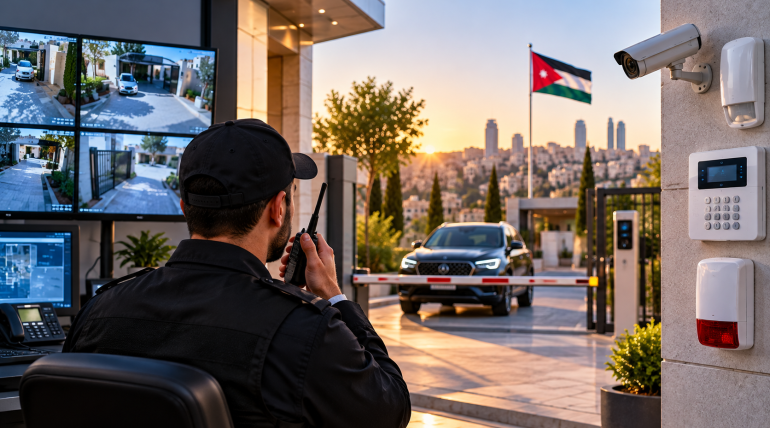
Protect What Matters Most with the Right Security Solution
Protecting your home is about more than installing cameras or locking doors. Effective home security requires a combination of appropriate technology, professional security procedures, trained personnel, and a protection plan designed around the specific risks of your property.
When comparing the best home security companies, homeowners should look beyond equipment and pricing. The right security provider should understand the property, identify potential vulnerabilities, recommend appropriate security measures, and provide reliable support when it matters most.
Whether you need to protect a family home, private villa, residential compound, farm, or larger property, this guide explains what to consider when choosing a professional home security company.
With more than a decade of experience in Jordan, Quick Intervention for Security & Armed Protection (Q.I.S.P) provides integrated security solutions designed to meet the different protection requirements of individuals, businesses, institutions, and properties.
What Makes a Home Security Company Stand Out?
Not every security provider offers the same level of expertise, technology, personnel, or operational capability.
When evaluating home security companies, consider the following factors.
1. Experience and Professional Credentials
Security experience matters.
An established provider should understand how security requirements differ between residential properties, villas, farms, commercial facilities, and other environments.
Experience also helps a security company identify vulnerabilities that may not be immediately obvious and recommend measures based on practical operational requirements rather than generic security packages.
Before selecting a provider, consider:
- Years of operational experience
- Licensing and regulatory compliance
- Types of properties previously protected
- Range of security services
- Operational capabilities
- Professional security procedures
A security company should also operate in accordance with applicable laws, regulations, and licensing requirements.
2. Trained Security Personnel
Technology is important, but trained security personnel remain an essential component of many residential security plans.
Depending on the property’s requirements, security personnel may support:
- Access control
- Visitor management
- Perimeter monitoring
- Incident response
- Security patrols
- Protection of entrances and sensitive areas
- Implementation of site security procedures
Where armed security is appropriate and legally permitted, the provider should ensure that personnel and operations comply with the applicable licensing and regulatory requirements.
The decision between armed and unarmed security should be based on a professional assessment of the property’s risks rather than assumptions.
3. Comprehensive Security Services
The best home security companies should be capable of recommending different security measures depending on the client’s requirements.
An integrated security solution may include:
- Armed and unarmed security personnel
- Alarm and monitoring solutions
- Surveillance systems
- Mobile security patrols
- Home and villa protection
- Farm and rural property protection
- Access-control measures
- Risk assessment
- Security consulting
- Rapid-response capabilities
Not every property requires every service. The objective is to select the appropriate combination of security measures for the property’s actual risks.
4. Technology Integration
Modern home security increasingly combines physical security with electronic security technology.
Depending on the property’s requirements, a security solution may include:
- Motion detection
- Door and window sensors
- Glass-break detection
- Surveillance cameras
- Smoke and fire detection
- Alarm notifications
- Remote monitoring capabilities
- Centralized monitoring
Technology should not operate as an isolated component.
Its greatest value comes when alarms, cameras, monitoring procedures, and security personnel are integrated into a coordinated security strategy.
5. Professional Response Procedures
An alarm is only one part of a security solution.
Homeowners should understand what happens after an alarm or security alert is generated.
Ask potential security providers:
- How are alarms received?
- How are alerts assessed or verified?
- What happens after an alarm is confirmed?
- Who coordinates the response?
- What escalation procedures are followed?
- How are incidents documented?
Clear procedures and operational readiness are important indicators of a professional security provider.
Core Services Offered by Professional Home Security Companies
Armed and Unarmed Security Guard Services
Professional security personnel can provide an important physical layer of protection.
Depending on the property and its risk profile, a security company may recommend armed or unarmed personnel.
Armed Security
Armed security may be considered for properties with elevated security requirements, subject to applicable laws, licensing, and professional risk assessment.
Examples may include:
- High-value residential properties
- Certain remote or isolated locations
- Residences requiring enhanced security measures
- Properties with specific identified risks
Unarmed Security
Unarmed security personnel may be appropriate for:
- Residential communities
- Access-control points
- Private compounds
- Properties requiring visitor management
- Low-to-moderate risk environments
The appropriate option should always be determined through a proper assessment of the property.
Mobile Security Patrols
Mobile patrols provide a flexible way to extend security coverage across larger properties or multiple locations.
Patrol services may include:
- Scheduled security checks
- Perimeter inspections
- Entrance and gate checks
- Monitoring of vulnerable areas
- Documentation of patrol activity
- Security response when required
- Visible security presence
Mobile patrols can be particularly useful for villas, residential compounds, farms, warehouses, construction sites, and larger properties.
They can also complement fixed guards, cameras, and alarm systems as part of a layered security strategy.
Smart Alarm Systems and Monitoring
Modern alarm technology can help identify potential security incidents at an early stage.
Depending on the system, security devices may include:
- Motion sensors
- Door and window sensors
- Glass-break detectors
- Smoke and fire detection
- Surveillance cameras
- Automated alerts
- Monitoring capabilities
However, homeowners should consider more than the equipment itself.
The effectiveness of an alarm solution also depends on proper installation, monitoring procedures, maintenance, communication, and the actions taken after an alert occurs.
For this reason, alarm technology is most effective when incorporated into a broader security plan.
Home and Villa Protection
Every residential property has different vulnerabilities.
A city apartment, private villa, residential compound, and large family property may each require a different security approach.
A professional residential security assessment may consider:
- Number of entrances and exits
- Property perimeter
- Existing cameras and alarm systems
- Lighting conditions
- Blind spots
- Visitor access
- Vehicle entrances
- Outdoor areas
- Property occupancy
- Surrounding environment
Based on this assessment, the security provider can recommend an appropriate combination of physical and electronic protection.
Farm and Rural Property Protection
Farms and rural properties can present additional security challenges because of their size, multiple access points, extended perimeters, and sometimes isolated locations.
An appropriate security solution may combine:
- Mobile patrols
- Surveillance
- Alarm detection
- Perimeter monitoring
- Access control
- Security personnel where required
- Regular security inspections
Because rural properties can differ significantly in size and layout, an on-site assessment is particularly important before determining the appropriate protection strategy.
Risk Assessment and Security Consulting
One of the most important steps in developing an effective home security plan is identifying the risks before deciding which equipment or personnel to deploy.
A professional security assessment may include:
- Inspection of the property and perimeter
- Review of entrances and exits
- Identification of blind spots
- Assessment of lighting and visibility
- Review of existing security systems
- Identification of access-control weaknesses
- Evaluation of property-specific risks
- Review of response procedures
- Recommendations for improving protection
The purpose of the assessment is not simply to recommend more security equipment.
It is to identify the measures that provide the most appropriate protection based on the property’s actual vulnerabilities and requirements.
How to Choose the Best Home Security Company
When comparing providers, consider more than the initial quotation.
Use the following criteria to evaluate potential security partners:
Evaluation Area
What to Consider
Experience
Established operational history and relevant experience
Licensing
Compliance with applicable regulations
Security Personnel
Training, supervision, and appropriate qualifications
Technology
Suitable alarms, surveillance, and monitoring capabilities
Response Procedures
Clear procedures for handling security alerts
Customization
Solutions based on individual property requirements
Risk Assessment
Ability to identify vulnerabilities before deployment
Support
Operational and technical assistance when required
Contract Terms
Clear scope of services and responsibilities
Pricing
Transparent quotation based on defined requirements
Price is important, but it should not be the only factor.
The cheapest security solution may not provide the appropriate level of protection, while an unnecessarily complex system may create additional cost without meaningful benefit.
The goal is to achieve the right balance between risk, protection, operational requirements, and budget.
Why Integrated Home Security Is More Effective
Home security works best when different layers support one another.
For example:
Security Layer
Main Function
Alarm Systems
Detect potential incidents
Surveillance Cameras
Monitor and document activity
Access Control
Manage entry to the property
Security Guards
Provide physical presence and response
Mobile Patrols
Extend coverage across larger areas
Monitoring
Receive and assess security alerts
Risk Assessment
Identify vulnerabilities and improve prevention
No single security measure can perform every function.
A camera can help monitor and document an incident, but it cannot physically intervene.
An alarm can detect a potential intrusion, but its effectiveness depends on what happens after the alert.
A security guard provides physical presence, while technology can improve detection and situational awareness.
This is why professional home security increasingly relies on integrated security solutions rather than a single protective measure.
Why Choose Quick Intervention for Security & Armed Protection (Q.I.S.P)?
With more than a decade of experience in Jordan, Quick Intervention for Security & Armed Protection (Q.I.S.P) provides professional security solutions designed around the specific requirements of each client and property.
Our approach focuses on combining security personnel, technology, operational procedures, and risk assessment into an integrated protection strategy.
Q.I.S.P security solutions can include:
- Armed and unarmed security personnel
- Home and villa protection
- Mobile security patrols
- Alarm and monitoring solutions
- Security technology
- Risk assessment
- Security consulting
- Customized security planning
- Rapid-response capabilities
Rather than applying the same security package to every property, Q.I.S.P evaluates the client’s requirements and develops an appropriate security approach based on the location, property type, operational needs, and identified risks.
Frequently Asked Questions About Home Security Companies
What should I look for when choosing a home security company?
Look for experience, proper licensing, trained personnel, appropriate security technology, clear response procedures, risk-assessment capabilities, transparent contractual terms, and the ability to customize services according to your property.
A professional provider should first understand your requirements rather than immediately recommending a standard package.
Do I need armed security for my home or villa?
Not necessarily.
Whether armed security is appropriate depends on the property’s risk profile, location, value, occupancy, and specific security concerns.
A professional risk assessment can help determine whether armed security, unarmed security, technology, patrols, or a combination of measures is most appropriate.
How do smart alarm systems improve home security?
Smart alarm systems can detect events such as unauthorized movement, opening of protected doors or windows, or other configured conditions.
When combined with professional monitoring and defined response procedures, they can provide an important early-warning layer within a broader home security strategy.
Are security cameras enough to protect a home?
Cameras are an important security tool, but they are generally most effective as part of a layered security solution.
Depending on the property, additional measures may include alarm detection, access control, security personnel, patrols, monitoring, and appropriate response procedures.
Can security companies protect farms and remote properties?
Yes.
Larger or remote properties may require solutions designed around their extended perimeter, access points, location, and operating conditions.
These may include mobile patrols, monitoring, surveillance, alarm detection, access-control measures, and security personnel where appropriate.
What is a residential security risk assessment?
A residential security risk assessment is an evaluation of a property’s vulnerabilities and existing protective measures.
It can identify issues involving entrances, perimeter security, lighting, surveillance coverage, blind spots, access control, and response procedures.
The findings can then be used to develop a more appropriate security plan.
Choose a Home Security Partner You Can Trust
Choosing among the best home security companies is ultimately about finding a provider capable of understanding your property, identifying its risks, and developing a security solution appropriate to your needs.
Professional home security is not simply about purchasing an alarm, installing cameras, or placing a guard at an entrance.
It is about bringing the right security measures together into a coordinated protection strategy.
With more than a decade of experience in Jordan, Quick Intervention for Security & Armed Protection (Q.I.S.P) provides integrated security solutions for homes, villas, farms, residential properties, businesses, and institutions.
Protect Your Home with Q.I.S.P
Every property is different. Your security plan should be too.
Whether you need home or villa protection, security personnel, mobile patrols, alarm and monitoring solutions, or a professional security assessment, Q.I.S.P can help determine the appropriate protection strategy for your requirements.
Contact Quick Intervention for Security & Armed Protection (Q.I.S.P) today to request a security consultation and customized protection plan.
Quick Intervention for Security & Armed Protection (Q.I.S.P)Integrated Security SolutionsJordan